
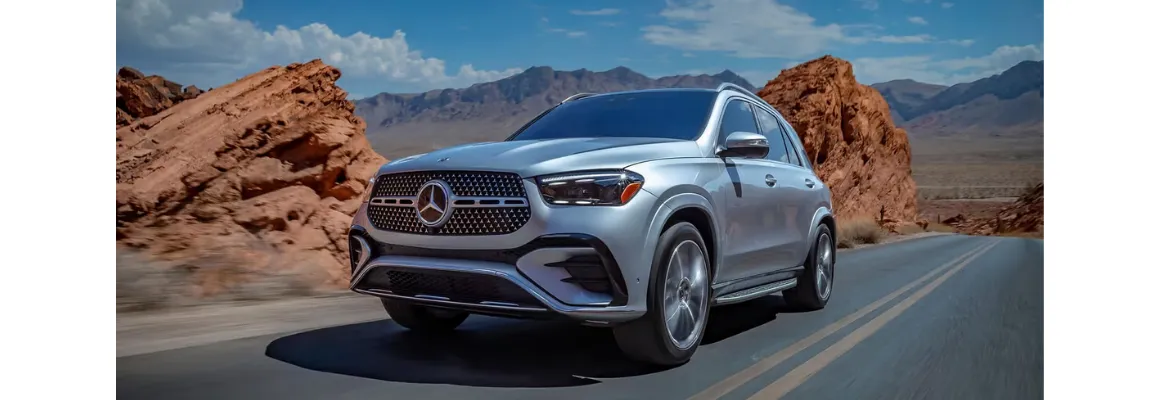
Mercedes-Benz 4MATIC AWD Explained
4MATIC is Mercedes-Benz name for all-wheel drive: it sends power to both axles to help the vehicle maintain traction. It isn't one single system. Depending on the vehicle, 4MATIC can use a mechanical drivetrain, an AMG performance system, or an electric motor at each axle.
Here's how the different versions work and how to decide whether all-wheel drive makes sense for your driving in Tucson.
How 4MATIC Works
A conventional 4MATIC system splits engine power between the front and rear axles and adjusts that distribution as driving conditions change, rather than powering only one axle.
The specific design depends on the vehicle. On the 2027 GLE, Mercedes-Benz describes 4MATIC as fully variable all-wheel drive, also called Torque on Demand. An electronically controlled multi-plate clutch in the transfer case can shift anywhere from 0 to 100 percent of the power between the front and rear axles. That range applies to the GLE system.
The Versions of 4MATIC
4MATIC
On gas and hybrid models, conventional 4MATIC uses mechanical drivetrain components to send engine power to both axles. The GLE Torque on Demand system is one example.
AMG Performance 4MATIC+
AMG Performance 4MATIC+ is Mercedes-AMG fully variable performance all-wheel-drive system. On the 2027 Mercedes-AMG GLC 53 4MATIC+, Mercedes-Benz describes the system as transitioning continuously between rear-wheel drive and all-wheel drive depending on conditions. It can also send more power to the rear starting in the ESP Sport setting.
Electric 4MATIC
Electric models use a motor at each axle to provide all-wheel drive, rather than a conventional transfer case. The 2027 C 400 4MATIC Electric uses two permanently excited synchronous motors, one at each axle.
The front motor works as a boost drive. A disconnect unit engages it when additional power or traction is needed and disengages it at low loads to help save energy.
4MATIC vs. Two-Wheel Drive: What You Gain and Give Up
Some Mercedes-Benz models are available with or without 4MATIC. The 2027 GLC 300, for example, is offered with rear-wheel drive or as the GLC 300 4MATIC.
What you gain:
Traction when accelerating: both axles can put power down, which helps on wet pavement, gravel and other loose surfaces.
Automatic adjustment: the system shifts power between the axles as conditions change, with nothing for the driver to switch on.
What you give up:
Price: the 4MATIC version costs more.
Fuel economy, slightly: EPA estimates for the 2027 GLC 300 are 23 city / 31 highway MPG with 4MATIC and 24 city / 32 highway MPG with rear-wheel drive. Actual fuel economy varies with driving conditions and habits.
How to Tell if a Mercedes-Benz Has 4MATIC
Check the full model name. When a model is offered in both configurations, the all-wheel-drive version includes "4MATIC" in its name. For example, the GLC 300 is rear-wheel drive, while the GLC 300 4MATIC is all-wheel drive. Electric models follow the same naming pattern, as with the C 400 4MATIC Electric. AMG models with the performance system use "4MATIC+".
The family name alone may not tell you which drivetrain a vehicle has. Check the full model name on the window sticker or vehicle listing. A listing that only says "GLC," for example, may not identify the drivetrain.
Do You Need 4MATIC in Tucson?
If most of your driving is on paved city streets and highways, you may not get much practical benefit from all-wheel drive. It can be worth considering if your regular driving includes:
Monsoon rain: Extra traction can help when accelerating on wet pavement.
Unpaved roads: Power at both axles can help maintain traction on gravel and other loose surfaces.
Winter trips: If you regularly drive to Mount Lemmon when roads are snow-covered or icy, 4MATIC can help maintain traction when accelerating.
Choose based on your regular driving needs, not just the possibility of occasional trips.
What 4MATIC Doesn't Do
All-wheel drive helps a vehicle get moving, but it does not improve braking. Slowing down and stopping still depend on the tires and brakes, and wet, icy, or loose surfaces can limit grip regardless of the drivetrain.
4MATIC also does not make flooded roads or washes safe to cross. Additional traction cannot overcome moving water.
Find a 4MATIC Mercedes-Benz at Mercedes-Benz of Tucson
Compare new Mercedes-Benz models and drivetrain options at Mercedes-Benz of Tucson.
Shop New Mercedes-Benz Inventory
Vehicle specifications, features, and equipment are based on manufacturer information and may vary by trim, configuration, and availability. Specifications are subject to change. Contact Mercedes-Benz of Tucson for current vehicle details.